FREE Shipping on orders over £50

info@1clickprint.com
01909 561888
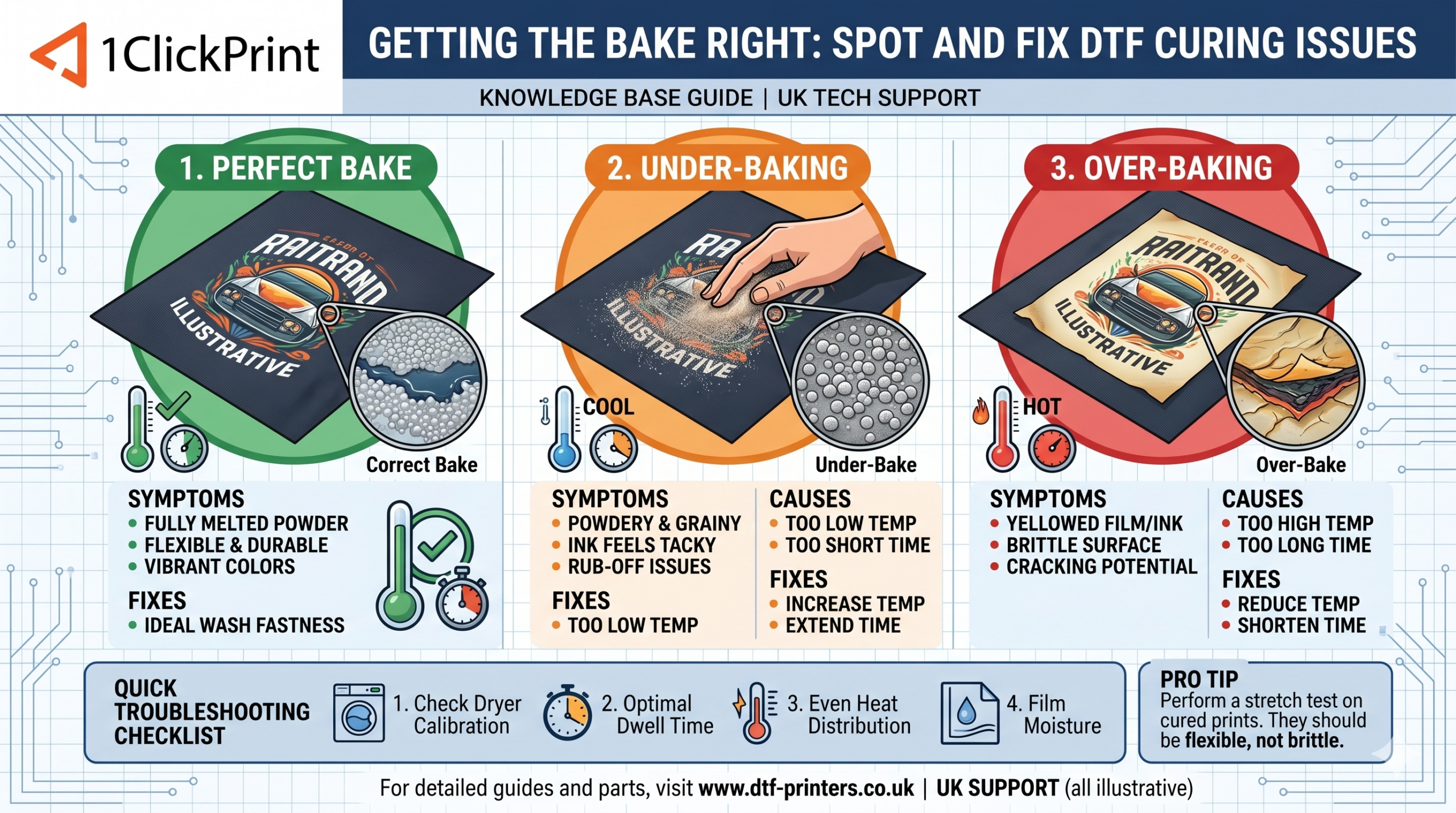
In the world of DTF, the “bake”—the moment your powder-coated film passes through the oven—is where the magic (or the misery) happens. Getting the cure spot on is the difference between a high-quality transfer that lasts fifty washes and a “dodgy” print that peels off before the customer even gets it home.
In our UK workshops, temperature consistency is often the culprit behind ruined batches. Here is how to diagnose if your oven is behaving itself and what to do if it isn’t.
If you aren’t sure whether your settings are right, your fingers and eyes will tell you everything you need to know.
If you run your hand over a cured print and it feels gritty, grainy, or like fine sandpaper, it is under-cured.
The Cause: The TPU powder hasn’t reached its “melt point.” It’s still sitting as individual grains rather than fusing into a smooth, rubbery skin.
The Risk: The print will likely crack when stretched, or worse, the adhesive won’t bond to the garment properly during the heat press.
If your brilliant whites are starting to look like a nicotine stain or have a faint yellowish hue, you are over-curing.
The Cause: The heat is too high or the film is moving too slowly. You are essentially scorching the ink and the adhesive.
The Risk: Over-curing can make the transfer brittle, cause the film to become “oily,” and ruin the colour accuracy of your designs.
Every machine has its “sweet spot,” but for our hardware, we recommend starting with these baseline temperatures. If you’re in a particularly cold or damp British workshop, you might need to nudge these up slightly, but stay within this range:
60cm Machines: Set your oven to 125 °C. These larger units have a longer heating path, allowing for a thorough “soak” at a slightly lower temperature.
42cm Machines: Set your oven to 135 °C. Because the curing window is shorter on these compact models, they require a bit more “punch” to get the powder to liquify in time.
A common point of confusion occurs when your oven display shows the “correct” temperature, but the prints are still failing. This is often caused by a failing heating element.
In our machines, the heating elements run horizontally across the width of the oven. Because they run from side to side, a failed element won’t cause one side of the print to be bad and the other to be good. Instead, it creates a much more deceptive problem.
The Dead Zone: When one horizontal element fails, that specific area of the oven becomes a “cool spot.”
The Overcompensation: The oven’s thermostat notices the overall temperature has dropped. To compensate, it keeps the remaining working elements switched on for much longer to try to reach the target temperature.
Hot and Cold Strips: This results in the areas directly under the working elements becoming massively over-heated, while the area under the dead element remains under-heated.
The Result: You can end up with a print that is over-cured (yellowing) in some sections and under-cured (sandy) in others—all while the control panel insists the temperature is exactly where it should be.
If you want to be 100% sure your bake is correct before you send a job out the door, perform a quick stretch test on a spare print:
Let the print cool completely after it comes out of the shaker.
Peel a small corner of the cured “skin” (or press a small sample to a scrap cloth).
Give it a firm tug.
Perfect: It should stretch like a rubber band and snap back without cracking.
Under-cured: It will crumble or feel “short” and brittle.
Over-cured: It might snap instantly or feel thin and “papery.”
| Machine Size | Target Temp | Symptom of Failure |
| 60cm | 125C | Yellowing (Too hot) / Sandy (Too cool) |
| 42cm | 135C | Yellowing (Too hot) / Sandy (Too cool) |
| Any | N/A | Patches of both (Failing heating element) |
