FREE Shipping on orders over £50

info@1clickprint.com
01909 561888
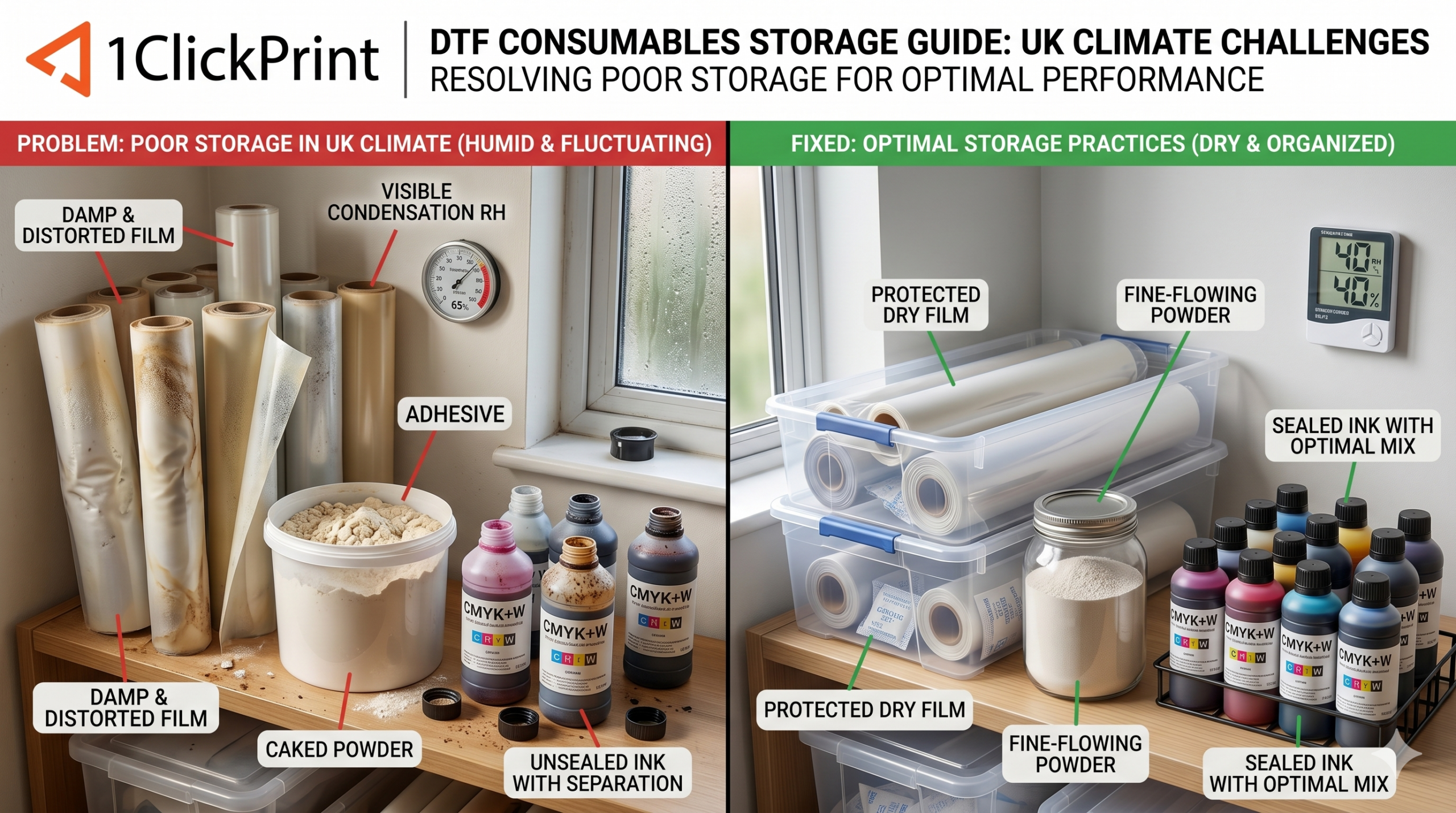
In the UK, we are relatively lucky. We don’t often deal with the 40°C heat of the desert or the 90% humidity of the tropics. However, our “changeable” weather—damp winters and the occasional summer heatwave—can still play havoc with DTF supplies if you aren’t careful.
Proper storage isn’t just about tidiness; it’s about preventing “oily” film and ensuring your white ink doesn’t turn into a layer of “cream cheese” at the bottom of the bottle.
It is a common myth that all ink needs constant shaking. In reality, your ink bottles behave very differently depending on what’s inside.
Your Cyan, Magenta, Yellow, and Black inks are typically water-based pigment inks that are very stable. The particles are light enough to stay in suspension almost indefinitely.
The Reality: You can leave a bottle of CMYK on the shelf for months, and it will be ready to pour immediately. No shaking required.
White DTF ink is a different beast entirely. To get that bright, opaque backing, manufacturers use Titanium Dioxide. This is essentially liquid rock. It is significantly heavier than the water/binder carrier it sits in.
The Reality: If left alone, gravity wins. The white pigment will eventually sink to the bottom.
You don’t need a lab kit to spot settling; just look at the bottle:
The “Gradient” Look: If the ink in a clear bottle looks translucent or yellowish at the top and brilliantly white at the bottom, it has started to settle.
The “Sludge” Test: When you pour the ink, if it starts thin and ends with thick, clumpy bits, you have a major settling issue.
The “Banding” Signal: If your prints look “weak” or greyish halfway through a run, the heavy pigment has settled in the tanks, and you are mostly printing the “carrier” liquid.
The Fix: Don’t shake it like a cocktail—this introduces micro-bubbles. Instead, turn the bottle upside down and roll it gently between your hands for 2 minutes.
In the UK, our biggest battle is humidity. DTF film has a coating designed to “grab” ink, which makes it hygroscopic (it actively sucks moisture out of the air).
If your film gets damp (common in a workshop that isn’t climate-controlled overnight), it develops a slight “tackiness” across the entire surface.
The Symptom: When you apply your TPU powder, the powder sticks not just to the ink, but to the unprinted parts of the film.
The Result: After curing, you get a “halo” or “snowy” effect—a faint, grainy white film around your design that ruins the finish on dark garments.
To avoid the “Halo” and keep your ink fresh, follow these UK-specific storage rules:
The Box Method: Don’t leave a roll of film on the printer overnight if your machine is in a cold, damp environment. Take it off and store it in a plastic airtight box.
Desiccant Packs: Throw several large silica gel packs into your film box. These will “eat” the British dampness before your film does.
Avoid the Floor: Never store ink or film directly on a concrete floor. Concrete draws out heat and causes condensation inside the containers. Use a shelf.
Temperature: Aim for 18°C to 24°C. If your workshop drops to 5°C overnight, you should expect a few niggles when you start printing.
| Consumable | Storage Priority | UK Specific Tip |
| CMYK Ink | Cool, dark place | Low maintenance; keep off the floor. |
| White Ink | Gentle agitation | Roll bottles once a week to prevent “rocking.” |
| DTF Film | Humidity control | Keep in a sealed bag or tub with silica gel. |
| TPU Powder | Moisture control | Keep the tub snapped shut; it clumps in damp air. |
